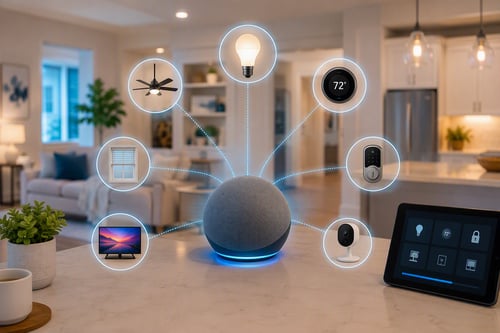
How to Set Up Alexa to Control Your Whole House
If you have looked at smart bulbs, plugs, locks, thermostats, or doorbells lately, you may have seen the word Matter on the box. It sounds like one more piece of smart home jargon, and that can make it easy to ignore. The good news is that Matter is actually meant to make smart home technology less confusing, not more.
In simple terms, Matter is a new smart home standard that helps compatible devices work together more easily across different brands and platforms. If you have ever worried that a device would only work with one app or one voice assistant, Matter was designed to reduce that frustration and give you more flexibility.
What Matter Actually Is
Think of Matter as a shared language for smart home devices. In the past, many devices spoke slightly different “languages,” so getting them to cooperate could feel messy. A smart plug might work well with Amazon Alexa, but not as smoothly with Apple Home or Google Home. Matter gives manufacturers a common set of rules so supported devices have a better chance of understanding one another.
Why the Smart Home World Needed It
That matters (pun intended) because the smart home world has often been more complicated than it should be. Many people like the idea of smart lighting, smart locks, or voice control, but they do not want to research five different apps, three different hubs, and a long list of compatibility warnings before buying a light bulb. Matter aims to lower that barrier.
For everyday users, one of the biggest benefits is simpler compatibility. A Matter-certified device may be easier to add to the smart home platform you already use, and it may still give you options if you switch platforms later. That can help you avoid feeling locked into one brand from the beginning.
How Matter Works in Plain English
Matter can also make setup feel more straightforward. In many cases, adding a Matter device is designed to be more consistent, often using a setup code that helps your smart home app recognize the device quickly. You may still need a compatible hub or speaker that helps certain devices connect behind the scenes, but the overall goal is to reduce guesswork.
You may also hear the term Thread mentioned alongside Matter. Thread is not the same thing as Matter. Matter is the shared rulebook, while Thread is one of the ways some devices can communicate behind the scenes. If that sounds technical, do not worry. The practical takeaway is simply that some newer smart home devices are being built to communicate more efficiently and reliably.
What Matter Does and Does Not Change
Still, Matter is not magic. It does not automatically make every old smart device compatible, and it does not guarantee that every advanced feature will work exactly the same in every app. A device may support Matter for basic controls like turning something on and off, while some extra features still work best in the manufacturer’s own app.
It is also important to remember that Matter does not replace good home network habits. If your Wi-Fi is weak, your router is outdated, or your internet service is inconsistent, a Matter label alone will not solve those problems. It can help with compatibility, but it cannot fix every smart home headache by itself.
Should You Care About Matter Right Now?
If you are starting a smart home setup, replacing older devices, or want more freedom to mix brands, it is worth paying attention to. If your current setup already works well, you do not need to rush out and replace everything. Matter is best seen as a helpful step toward a simpler smart home, not a reason to throw away working technology.
The bottom line is that Matter is a new standard designed to make smart home devices easier to set up, easier to mix and match, and less frustrating to live with. Give us a call, or fill out the contact form to the right (below on mobile), for a personalized consultation to secure your family's or business's digital life.
Kevin Mewborn
Sep 4, 2026, 9:00:00 AM
Sep 4, 2026, 9:00:00 AM

Comments